
What Happens During a TAPS Investigation: A Complete Walkthrough
From the moment our team arrives to the debrief a week later — a step-by-step look at exactly what a TAPS investigation involves, and what you can expect throughout.
Most people who submit a case request have no idea what to expect from the investigation itself. Television shows a lot — the equipment, the darkness, the tense moments — but it edits out the hours of methodical, unglamorous work that make those moments mean anything. This post is about the whole thing, from first contact to final report.
Before We Walk in the Door
The investigation starts before we arrive. After your case is reviewed and a case manager contacts you for the intake conversation, we begin research. Depending on the property, that might mean reviewing building permits and renovation records, researching the history of the site, checking for documented environmental hazards in the area, and cross-referencing your reported experiences with any patterns we've seen in similar locations.
We also use this phase to understand who is in the home — whether there are children, elderly residents, or individuals with specific medical or psychological needs. That context shapes how we approach the investigation and how we communicate our findings.
The Environmental Assessment
When the team arrives, the first thing we do is not set up cameras. The first thing we do is walk the entire property with no equipment at all. We're looking for environmental factors: sources of infrasound, areas of poor ventilation, unusual temperature patterns, evidence of structural issues, signs of electrical problems. We're cataloguing every known rational explanation for every area of the property before we place a single device.
This phase can take two to three hours on its own. We check for carbon monoxide at sub-threshold levels — below what standard detectors catch — because CO exposure is one of the most common causes of reported haunting symptoms. We map EM field levels throughout the property. We test acoustics in every room.
Field Note
Field Note: We've found sub-threshold carbon monoxide in roughly one in twelve residential investigations. In every one of those cases, the reported activity was consistent with known CO symptoms. The furnace or appliance gets fixed; the activity stops.
Equipment Setup and Baseline
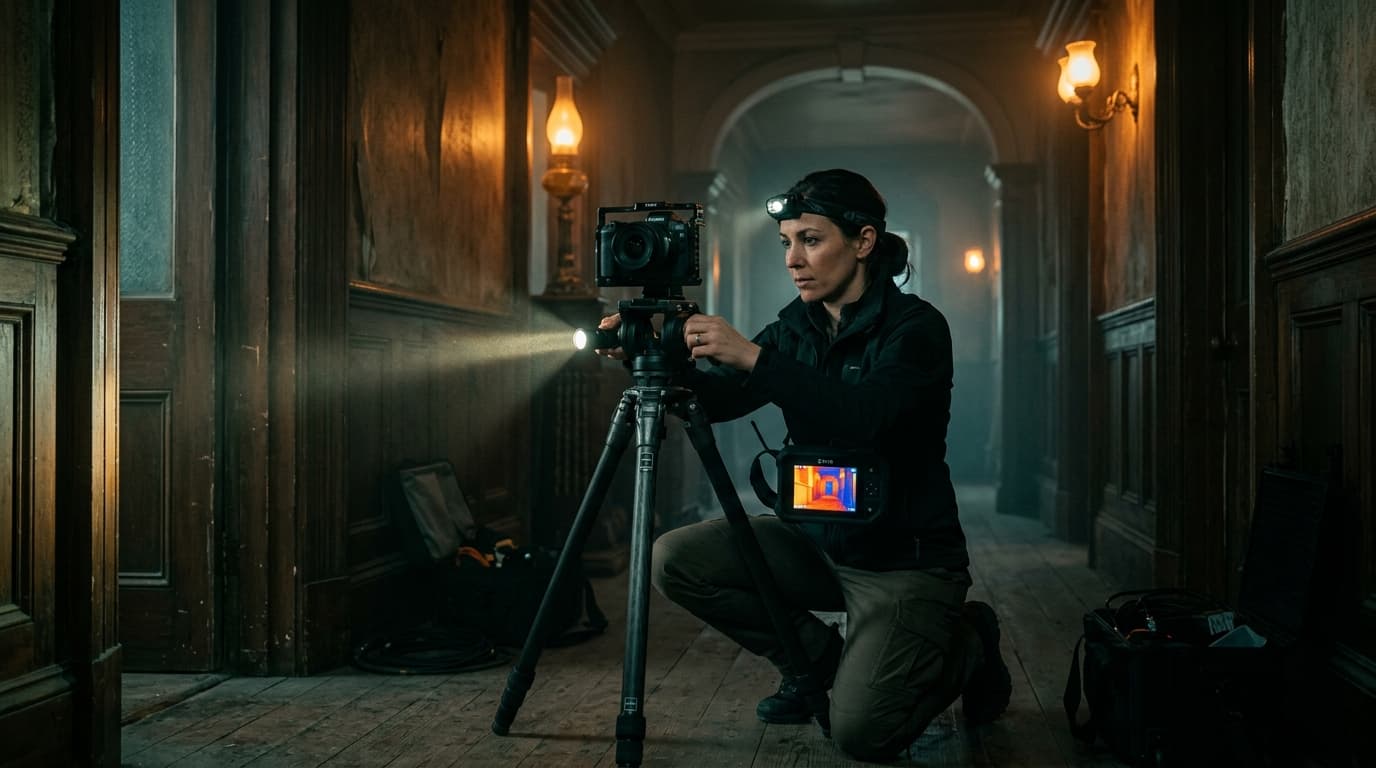
Once the environmental assessment is complete, we set up equipment. Static cameras cover the areas of highest reported activity. Audio recorders are placed at intervals throughout the property. Thermal cameras are positioned at corridor junctions and doorways. Every device is time-synchronized so that if we capture something on multiple devices, we can establish correlation.
Before we begin active investigation, we run a one-hour baseline recording with no investigators present in the spaces being monitored. This gives us a reference point — a record of what the property's ambient sound, temperature, and EM environment looks like without any human presence. Everything captured during the investigation is compared against that baseline.
The Investigation
The active investigation typically runs through the night. Teams of two rotate through different areas of the property, spending extended time in the locations where activity has been reported. We conduct EVP sessions — structured periods of silence with open audio recording, asking direct questions and waiting. We run thermal sweeps. We respond to any real-time equipment responses with systematic follow-up.
When something happens — a K2 response, a sound, a thermal anomaly — we don't call it evidence. We attempt to reproduce it. We test every possible mundane source. If we can reproduce it, we document the source and move on. If we cannot reproduce it after thorough testing, we mark it as unexplained and continue building data.
“When something happens, we don't call it evidence. We spend the next hour trying to prove it's nothing.”
Evidence Review
After the investigation, the real work begins. Every hour of audio from every recorder is reviewed. Every hour of video is reviewed. Thermal data is analyzed. EM logs are cross-referenced. We're looking for correlations — multiple devices capturing something in the same location at the same time — because a single-source anomaly is far less meaningful than a multi-source one.
This process typically takes several days, depending on the size of the investigation and the amount of material captured. We do not share preliminary findings with clients. We present the full picture when the review is complete.
The Debrief
The debrief is the most important conversation of the entire process. We sit down with you — in person or by video — and walk through everything we found. Every rational explanation we identified. Every piece of evidence we couldn't explain. The environmental factors we documented. Our recommendations.
If we found a rational cause — a mechanical issue, a CO problem, an electrical issue — we tell you exactly what it is and what contractor you need. If we found unexplained evidence, we explain precisely what it is, how it was captured, what we ruled out, and what it does and does not tell us. We don't speculate beyond the data. We don't tell you what you want to hear.
After the Investigation
Every client receives a written summary of our findings. Cases with unexplained evidence are kept in our active files; we may request permission to return for follow-up investigation. Cases with rational explanations are documented and closed, with referrals to any contractors or specialists who should be involved.
We remain available to clients after the investigation is complete. If activity continues, if something changes, if you have questions about what we found — you can reach us. The case doesn't close until you have answers.